Gideon Zelermyer Cantor · Tenor · Teacher

2009 —

In print.

The prayerbooks edited from the ground up for one congregation’s own customs, a scholarly publication for the Hebrew University of Jerusalem, one sermon a year on the Sabbath the Torah reaches the Song of the Sea, and a month of posters arguing for the second day of Rosh Hashanah.

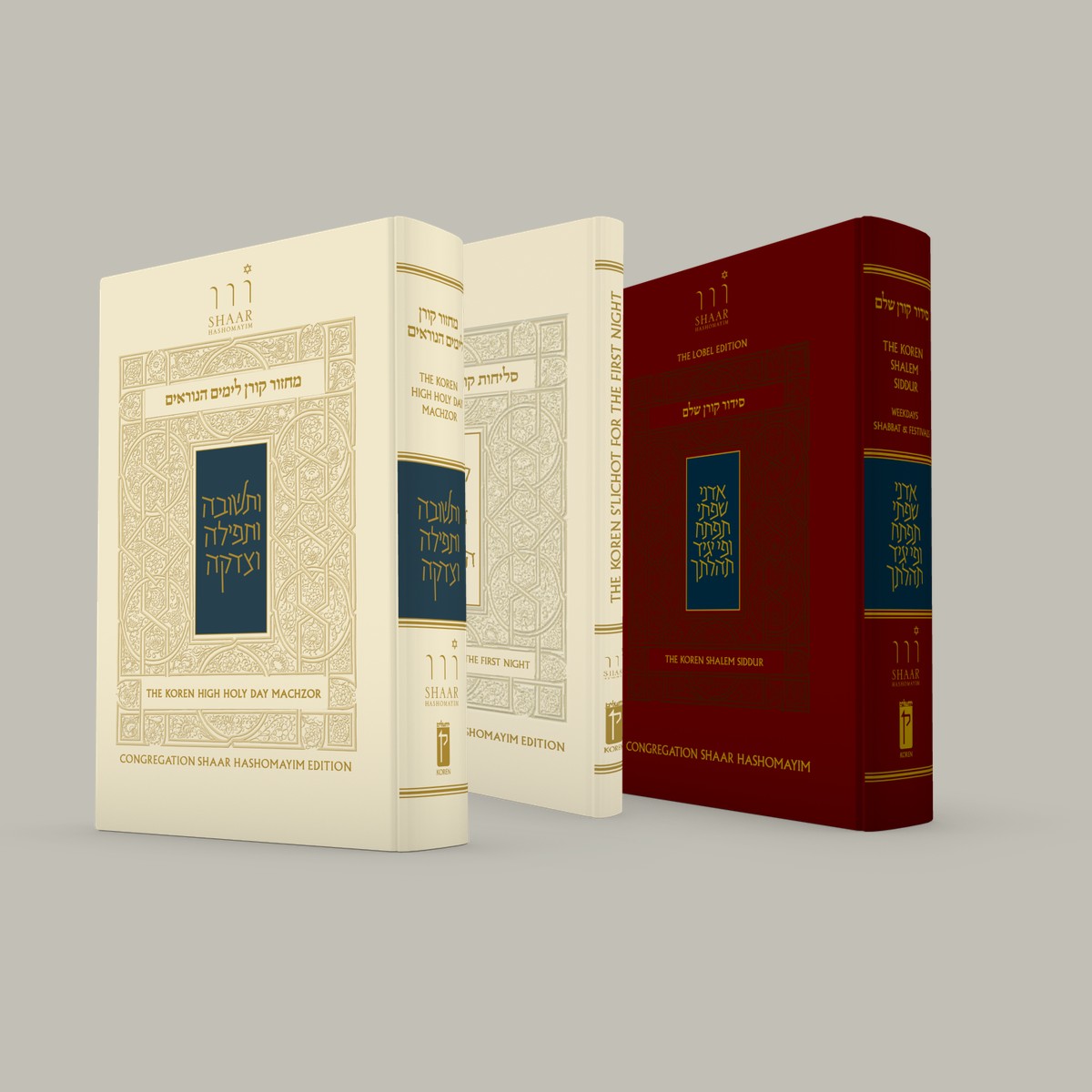
The three Shaar Hashomayim prayerbooks lined up as on a shelf: the Koren High Holy Day Machzor in front with its ornamented cover, and behind it the spines of the Koren S’lichot for the First Night and the Koren Shalem Siddur.
The three Koren volumes edited for Congregation Shaar Hashomayim.

Bespoke liturgy

The prayerbooks

Three volumes, edited over several years and built from the ground up for The Shaar's own customs: a Siddur, a High Holy Day Machzor, and a volume for the first night of S'lichot — each based on the translation and commentary of the late Rabbi Lord Jonathan Sacks, published by Koren Publishers of Jerusalem.

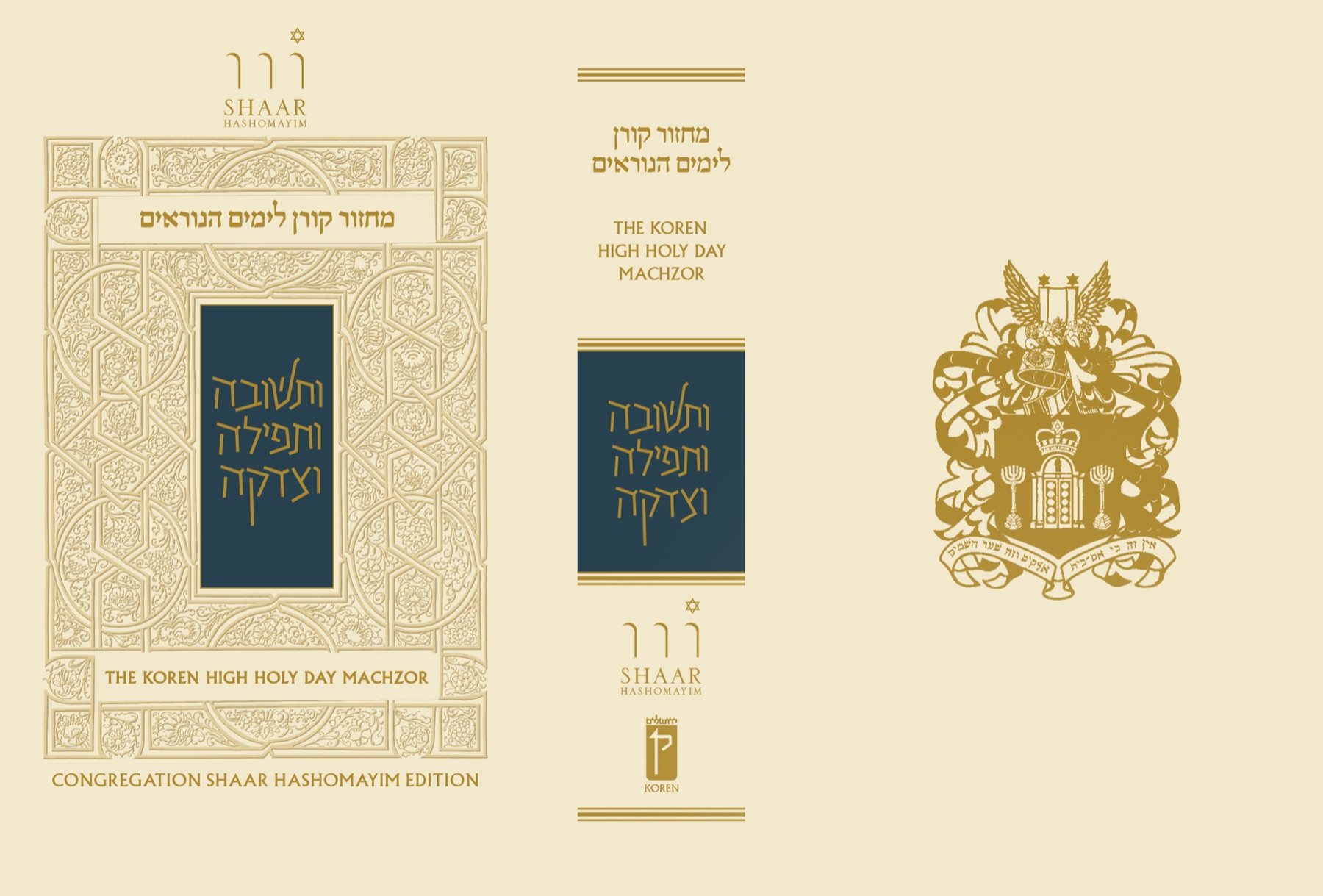
Full cover spread of The Koren High Holy Day Machzor, Congregation Shaar Hashomayim Edition — front, spine and back with the Shaar Hashomayim crest.

The Koren High Holy Day Machzor

2017 · Congregation Shaar Hashomayim Edition · Koren Publishers, Jerusalem

For generations, congregants at The Shaar davened the High Holy Days from three incompatible machzorim, none suited to the congregation's own customs. Zelermyer edited this volume — a project of months of drafts across more than 1,400 pages, arriving a year after the congregation's 170th anniversary — to put everyone on the same page, literally, for the first time in the synagogue's history.

Early research turned up something unexpected: The Shaar's rituals differ, in small but persistent ways, from normative Ashkenazi practice. Koren traced the discrepancies to the congregation's own origins and its ties to Anglo Jewry, and recommended building the volume on Minhag Anglia — the customs of British Jewry — rather than the standard Ashkenaz text. Further research bore this out: the book is grounded in the same British traditions that shaped the congregation at its founding in 1846.

The result carries Rabbi Lord Jonathan Sacks's English translation and commentary, with further contributions — unique to this edition — from Leon Wieseltier and Ruth Wisse, and abundant transliteration throughout so that congregants of every level of Hebrew fluency can follow and take part.

To be known, from this edition forward, as Minhag Shaar Hashomayim.

The teaser released ahead of the Machzor, September 2017.
"Printing holy books is in my blood. Drukkerij Levisson — Levisson Printers — of The Hague saved the lives of my maternal grandfather, Benno Levisson, and his parents and siblings, from the horrors of the Holocaust. A bust of my great-grandfather, Levie Levisson, is on display at the Joods Historisch Museum in Amsterdam, together with his printing plates, honouring the generations of my family who produced volumes both sacred and secular in Holland." Cantor Gideon Zelermyer, from the Machzor's introduction
TEXT & COMMENTARY
Rabbi Lord Jonathan Sacks
ADDITIONAL COMMENTARY
Leon Wieseltier
Ruth Wisse
EDITOR
Cantor Gideon Zelermyer
With the clergy and music leadership of Congregation Shaar Hashomayim, and the editorial team at Koren Publishers, Jerusalem.

Full cover spread of The Koren S'lichot for the First Night, Congregation Shaar Hashomayim Edition — front, spine and back with the Shaar Hashomayim crest.

S'lichot

2019 · For the first night of S'lichot · Koren Publishers, Jerusalem

The second of the three volumes, for the late-night service that opens the High Holy Day season — The Shaar's own custom, in Koren's format, alongside the Machzor and Siddur. The volume is dedicated to the memory of Rabbi Wilfred Shuchat, who led the congregation for longer than anyone in its history.

TEXT & COMMENTARY
Rabbi Lord Jonathan Sacks
EDITOR
Cantor Gideon Zelermyer
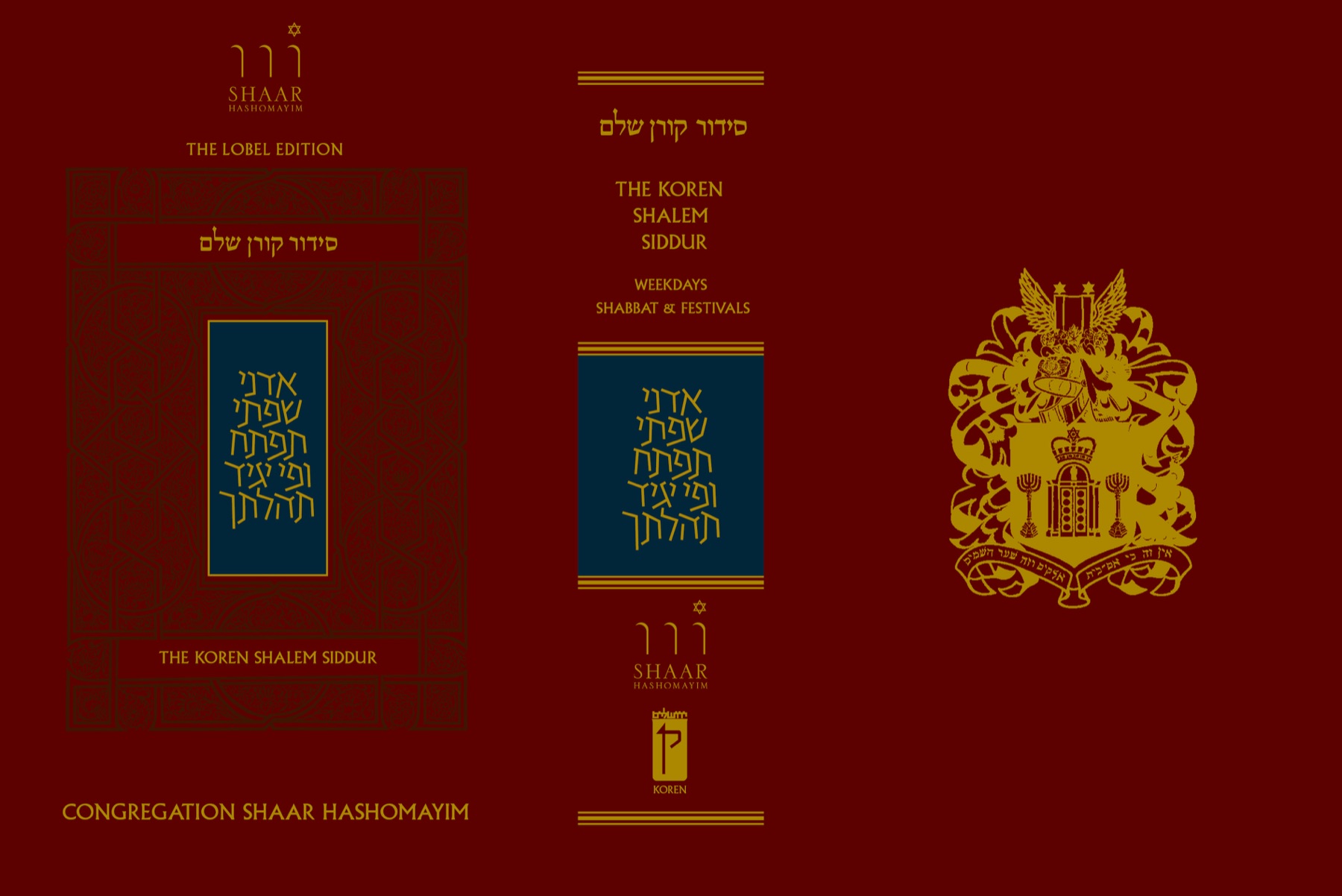
Full cover spread of The Koren Shalem Siddur, The Lobel Edition, Congregation Shaar Hashomayim — front, spine and back with the Shaar Hashomayim crest.

The Koren Shalem Siddur

2023 · The Lobel Edition · Weekdays, Shabbat & Festivals · Koren Publishers, Jerusalem

The daily and Shabbat companion to the Machzor, built on the same principle and the same British-rooted customs — one volume, tailored to The Shaar's own minhag, for the rest of the year.

TEXT & COMMENTARY
Rabbi Lord Jonathan Sacks
EDITOR
Cantor Gideon Zelermyer

Published, 2009

Scholarship & collections

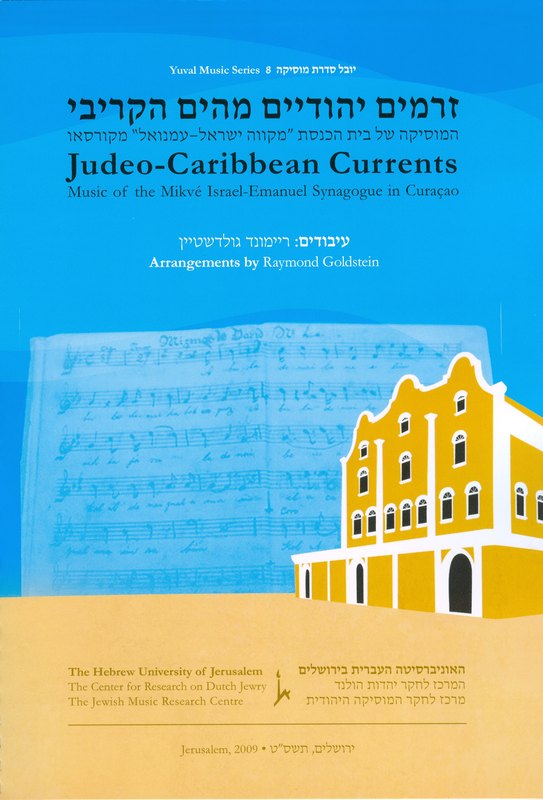
Cover of Judeo-Caribbean Currents — the yellow Snoa synagogue of Curaçao against a blue ground, with a manuscript page behind it.

Judeo-Caribbean Currents

2009 · Jewish Music Research Centre, Hebrew University of Jerusalem

The liturgical tradition of the Mikvé Israel-Emanuel synagogue in Willemstad, Curaçao — established 1654, and the oldest Jewish congregation in the Western hemisphere. Published as volume 22 of the Anthology of Music Traditions in Israel, with liner notes by Edwin Seroussi.

The material was drawn from fifteen boxes of old music in the synagogue's archive, covering nearly a century and a half of practice. Much of it survived only in fragments, and much of it turned out not to be Portuguese at all: local composition, and a great deal imported from western Europe and America. Raymond Goldstein reconstructed and arranged the whole collection for voice and piano. Twenty-eight tracks resulted, among them five settings of Adon Olam, a wedding piece adapted from Lewandowski of Berlin, Bendigamos in Spanish, and a Marcha Nupcial written by the Venezuelan composer Sebastián Díaz Peña for a Jewish wedding on the island in 1916.

Six of the pieces are still sung at Mikvé Israel-Emanuel today.

Zelermyer's mother's mother's mother was Maud Capriles. The line runs back to Dr Joseph Capriles, who married at Mikvé Israel in August 1762, and Capriles descendants have served on that synagogue's board ever since. This is not a visiting cantor's recording of someone else's tradition. It is his family's synagogue.

GIDEON ZELERMYER
hazzan

RAYMOND GOLDSTEIN
piano; arrangements

EDWIN SEROUSSI and
YUVAL SHAKED
editors
Vocal ensemble
Naama Nazarathy · soprano
Shelly Berlinsky · alto
Evan Cohen · tenor
Jay Shir · bass
Anthology of Music Traditions
in Israel, vol. 22
Yuval Music Series 8
Jerusalem, 2009
Published by the
Jewish Music Research Centre
and the Center for Research
on Dutch Jewry
,
Hebrew University of Jerusalem
Reviewed in Musica Judaica Online
Rebecca S. Miller, 2011

Shiru Lo Shir Chadash

Two CDs · The complete compositions of Rabbi Cantor Geoffrey Shisler, Book 1

Shisler, a rabbi-cantor in London, had never expected his synagogue compositions to be published. Cantor Arie Subar heard him present them at the European Cantors Convention in London in 2005, thought they deserved a wider hearing, and set about it with Stephen Glass — both Montrealers. The Council of Hazzanim of Greater Montreal published the volume in 2009.

Every piece in the book was recorded by Zelermyer, with Glass's arrangements, and Glass's harmonisations are printed throughout as chord symbols so that the music can be learned by people who do not read notation. The discs are not a selection: they are the whole book, made as a working reference for cantors and baalei tefillah anywhere.

One of the settings, Rachamana, went on to appear on the soundtrack of Labyrinth of Lies.

GEOFFREY SHISLER composer
GIDEON ZELERMYER cantor
STEPHEN GLASS arrangements
Published by the Council of
Hazzanim of Greater Montreal
2009
Shisler’s page for the volume
Book 2, edited with Charles Heller of Toronto, has no accompanying discs.

18 November 2016

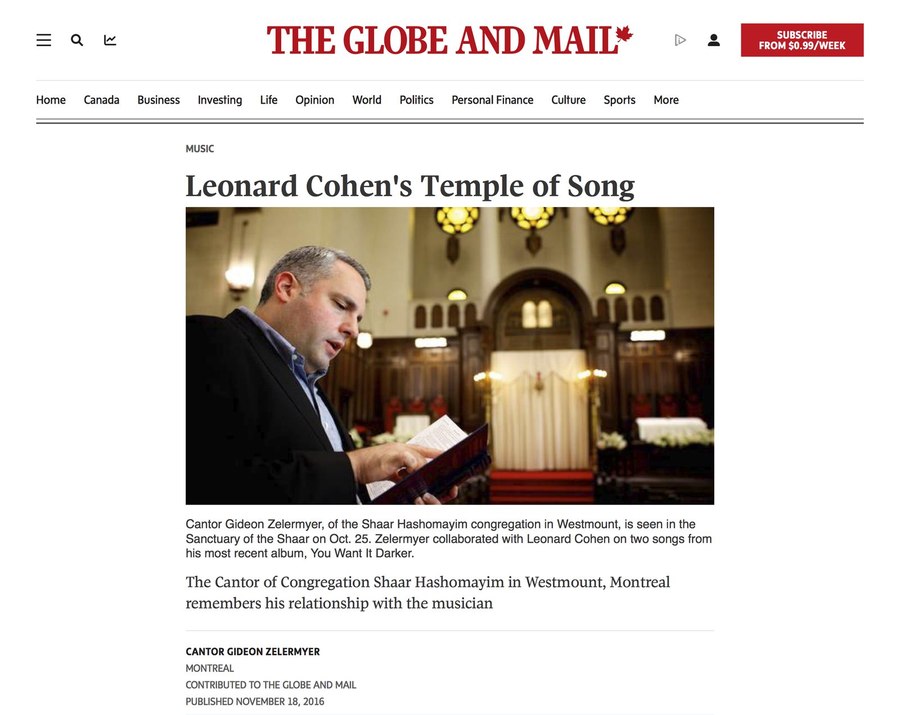
In the Globe and Mail

Eleven days after Leonard Cohen’s death, and eight after the funeral he conducted, Zelermyer wrote his own account of the seven years between them.

The correspondence, the invitation to sing on You Want It Darker, the visit to the graves on Mount Royal before Rosh Hashanah, and Chazak, chazak v’nitchazeik — the last words the two men exchanged. Leonard Cohen’s Temple of Song →

The top of the Globe and Mail article as published: the masthead, the headline Leonard Cohen’s Temple of Song, and a photograph of the cantor reading from a book in the sanctuary.
As it ran in The Globe and Mail, 18 November 2016. The full page →

Elul 5786

Don’t miss Day 2

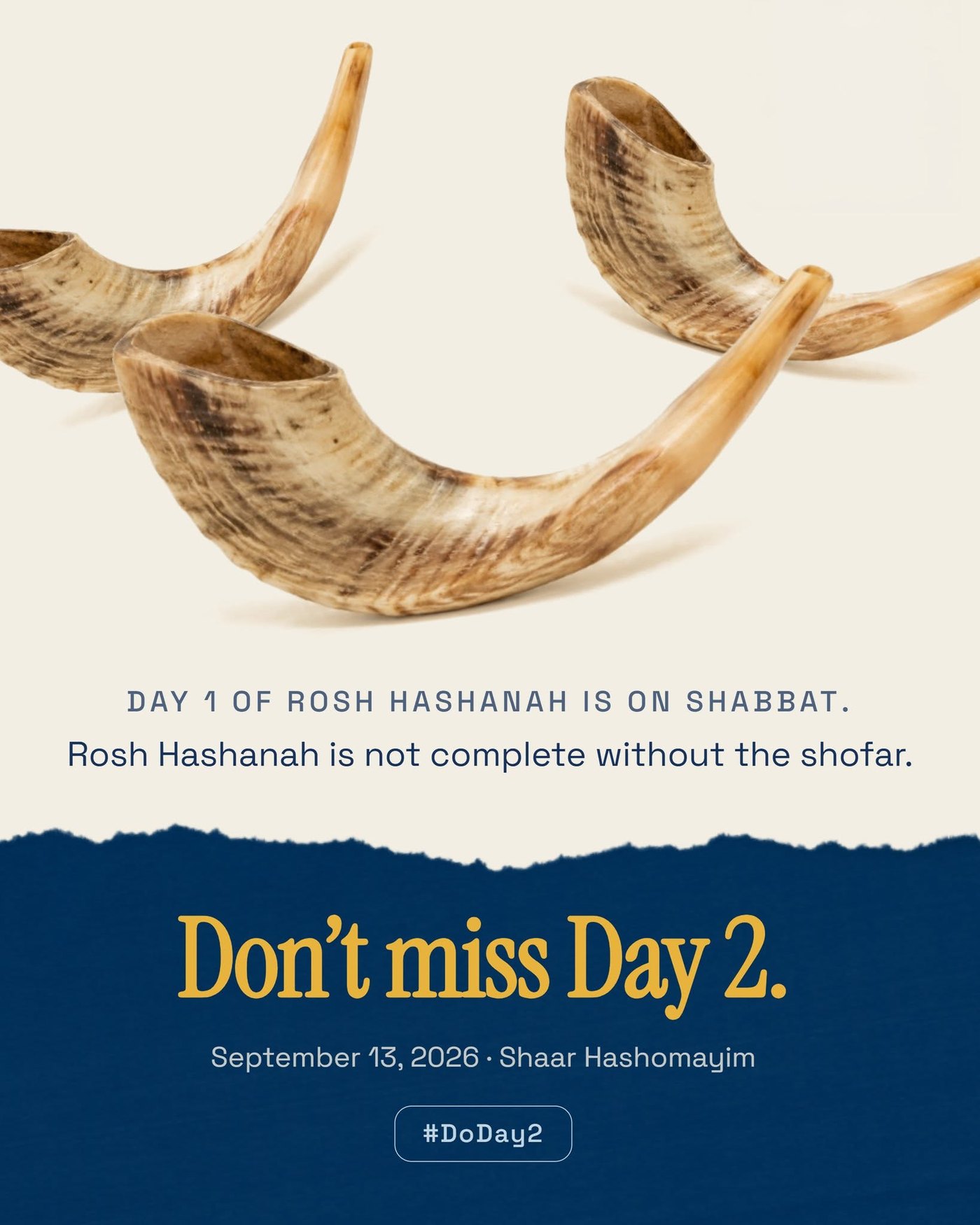
In 5787 the first day of Rosh Hashanah fell on Shabbat, when the shofar is not sounded — leaving the whole festival’s hundred blasts on the second morning alone.

Rather than argue it from the pulpit, Zelermyer argued it twenty-five times over a month, six days a week: a bagel without the lox, a sundae without the cherry, the flag without the maple leaf, the Habs without the CH — the missing thing replaced, each time, by a shofar. The whole month, day by day →

The opening post: three ram’s horns on a cream ground above the words Day 1 of Rosh Hashanah is on Shabbat, Rosh Hashanah is not complete without the shofar, and Don’t miss Day 2.
The first of the twenty-five — 1 Elul, 14 August 2026. Artwork — Zelly Design Co.

One a year, since 2010

Shabbat Shirah

Once a year the Torah reading is the Song of the Sea, and at Shaar Hashomayim the cantor gives the sermon rather than the rabbi.

Fifteen of them are collected on their own page, each with the text as delivered and a PDF — on a synagogue named for a great-grandfather, on what a choral synagogue is, on how anyone knew how to sing it. The sermons →

A wave breaking in deep blue water off Curaçao, white foam filling the foreground, the horizon and a line of cloud beyond.
The sea off Curaçao. Photograph — Heske Zelermyer.